3/14/12

The Walking Dead - Season 2, Episode 12 - "Better Angels"

Spoilers ahead, everyone. You have been duly warned.

"Better Angels" signals the point at which The Walking Dead has found its bearings as a series.  We'll get to the details of this week's episode in a bit, but some more general remarks at first.

First off, TWD one again makes the case that the writers are perhaps a little smarter than we give them credit for, as might be signaled in the irony of the title of this episode versus the revelations about the inner workings of the RV Gang.  Life in the World of Walkers has its own rules, and much of the soap-opera business of the first half of the season seems better understood as a sort of parody of life in the old world, articulated by good old Dale (now dead), Hershel (now deferential to Rick), and Lori (who continues to "play house," as pointed out by Andrea).  Rick'a advice to Carl last week, "Don't talk -- think!" is a useful bit of advice for watching the show.  Pay little attention to the words coming out of people's faces; all that talk doesn't mean jack when the zombies start heading your way.

Secondly, although Shane's death might on initial consideration seem to be the big development of the week, there's a larger change to the rules of TWD universe: the newly dead, those not necessarily bitten or scratched by walkers, will now become walkers in a matter of minutes once they die.  This had been hinted at previously, but Daryl, the current expert on zombies, quickly notes the peculiarities of Russell's appearance as a walker in the woods that night.  I had considered the possibility that what Dr. Jenner had whispered to Rick back in Season 1 ("TS-19") might have been about the walker virus mutating.  Rick's lingering over Shane's body could have been read as a consequence of that bit of information, but that moment was too full of ambiguity to be understood in just that way.  But Shane's popping up just moments after his death unambiguously lets us know that the rules for walkers have changed.

Finally, and the producers may have waited a little too long for this principle to sink in for viewers not familiar with the comics, but people should expect any character to die at any moment.  You can guess as to which one or two characters might make it through the entire run of the series, but the exits of Dale and Shane in the past two episodes are much more in keeping with the ethos of the comic.  Dale was too idealistic -- or rather, too distracted by his ideals -- to survive.  Shane was too impulsive -- too noisy, and, in another way, too romantic -- to survive.  Part of survival is knowing when to fight as well as knowing when to keep quiet.

Fighting and keeping quiet -- that's the way Rick takes care of business when it comes time for a final confrontation with Shane.  One of the great pleasures of "Better Angels" is watching Jon Bernthal finally lose his shit, to the point where many in the audience must have finally understood that he was truly a danger to the RV Gang, even though his reasons for his endgame are credible.  But he broke Russell's neck, then smashed his face into a tree and broke his own nose.  That's just crazy.  But Lori will do that to a person; she's not exactly helping matters with her ongoing inability to make a decision and stay with it.

The fact that Shane would take himself and three other capable zombie-killers (Daryl, Glenn, and Rick) out into the woods at night looking for an "escaped" prisoner is evidence enough of his liability.  Once the search party goes into the woods, we don't much of what happened "meanwhile, back on the ranch," aside from Carl's sneaking off.  After the search party splits up, it was great to see Daryl continue to demonstrate how awesome he is as The Redneck Superhero, and Glenn did okay in dispatching a walker with his handy machete.  Yes, folks, you should be seeing much more of Glenn as a capable survivor in the days to come.

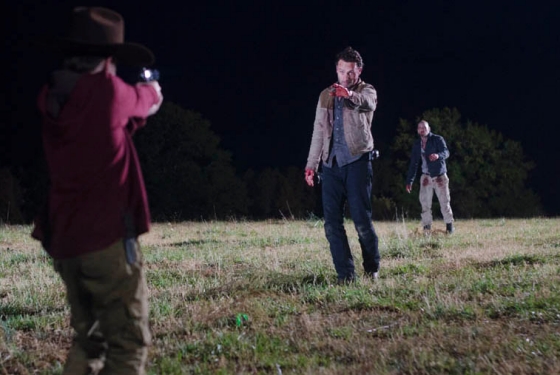
But the scene that took everyone's breath away was the final showdown between Rick and Shane in that moonlight field with the mists gathering.  All credit to the actors for drawing us in:  Shane's strangely resigned murderousness versus Rick's nervous negotiation, right up to the moment when he slips the knife in.  The word that's been thrown around to describe the scene is 'Shakespearean,' and that's fair.  Shane got what he deserved, tragic as it was; Rick did what he had to do, much as it pained him, and, what's more, the stealthy manner in which he offed Shane makes one admire Rick even more as a leader.  That was pretty damned impressive as a test of nerve and skill.  Bravo.

All the more epic is the presence of Carl -- who, fearing for his father, has slipped out into the night and witnessed the showdown.  Of course, in the comics, it's actually Carl who guns down Shane - not Zombie Shane but Crazy Shane -- but I was just as happy with the way that Carl saved his father from Zombie Shane.  I got your back, Dad.  Carl doesn't strike me as sentimental about survival; it was Carl who showed up at the barn last week and encouraged his father to shoot Russell the prisoner.  And, as much as Shane tried to be a father to Carl, it's Rick who finally gives Carl a gun and, more to the point, recognizes the fact that his son is right: Carl can handle himself.  Although the writers could make this into an incident that drives Rick and Carl apart, I would guess that it draws them closer together.  As for Rick and Lori, who can tell?

The possibilities raised by this episode will likely make for a rousing season finale, and one that shouldn't feel too cheap.  The herd of walkers emerging from the woods after the nocturnal gunfire can't be good.  The death of Shane and Rick and Carl's part in it will certainly cause a stir among the RV Gang.  The mutated zombie virus is disturbing news.  And, let's not forget that before Russell had his neck snapped, he told Shane that the camp for his crew of 30 Armed Bad Guys wasn't more than five miles away.  As with the best shows that have an ongoing, serial plot, I would expect that much of what was built in Season Two will be burned to the ground to make way for Season Three.

Zombie Kill of the Week:  Carl, with a clean head-shot to Zombie Shane
Zombie Quotient - from 1 (none) to 10 (major herd) - 4

3/10/12

The Walking Dead - Season 2, Episode 11 - "Judge, Jury, Executioner"

Spoilers lurking. . .


The teaser for this episode leaves no doubt as to the new morality -- amorality? moralities? -- in the world of walkers.  We open quite suddenly on Daryl and the stranger -- whose name we learn is Russell -- as Daryl works him over for information, blow by blow, picking at Russell's nasty scab with a buck knife until Russell tells what he knows about Curious Dave and Fat Tony's Gang.  There are about 30 men with artillery and automatic weapons, and that shortly after Russell joined them, they captured and raped a couple of teenage girls.  Thanks very much, shit-bird.  Whap. Boom.  Roll opening credits.  It's dirty business, and what Daryl does best.

Then we return once again to the RV Gang's attempts to maintain civilization in one way or another.  The obvious question of the day is what is to be done with Russell?  Dale, persistent as ever in his role as Defender of the Old Morality, appeals to Rick for some process in deciding Russell's fate.  Very well, Dale, Rick will give you to sundown to talk to everyone in the camp, at which point a decision must be made.  How very Aristotelian of you!  And so Dale goes about his day, having his usual Dale conversations with people -- painfully obvious and strained.  For me, Dale's become an annoyance, and I have to wonder if that's the case for other viewers as well.  As much as he might plead for mercy for Russell, we also see how Russell might just be tricky enough to be still working for The Evil Gang of 30.  To my reading, all of Dale's pleading is really a final goodbye to the Old Morality.  There's a lot of Dale in this episode, with a nice scene involving Glenn and Hershel and a pocket watch.  But the real action lies with Carl.

Carl's the new sheriff in town.  That's why he wears the hat.  He's been shot and lived.  He's seen his share of walkers.  His friend Sofia got turned into one and then was gunned down in front of him.  If a boy's going to have an appropriately grim view of the world, it's Carl.  And as much as people tell him to act his age, Carl can handle himself.  The best bit of advice his father Rick can give him is, "Don't talk, think!"  Growing up quick in the world of walkers, Carl's got a chance to see things more clearly than the others.

The best scene in the episode happens when Carl, having found a pistol along Daryl's things, sets off into the woods on his own -- everyone's arguing about Russell, you see -- and finds a walker stuck in the mud.  Rather than run away, Carl stops and studies the creature.  For a long long time.  In fact, he gets as close as he can to it.  There's a cold curiosity to Carl in these moments that is familiar -- the same uneasy fascination some might have at pulling the wings off houseflies or burning ants with sunlight and a magnifying glass.  In fact, Carl's ready to put a shell in the walker's skull when the deadhead gets his foot loose.  Carl gets away, but he drops the gun.  Remember that gun.  And remember the zombie, for that matter.

At sundown, Carl's returned, just in time to be shooed away from the talk between all the grown ups about what to do with Russell.  In the end, Dale almost makes the case for sparing his life.  If Russell is executed, the new world wins.  "It's ugly.  It's harsh," says Dale.  "It's survival of the fittest."  As he walks out, disgusted, he says to Daryl, "This group is broken."  Well, maybe.  There are some in the audience who might agree with Dale, but this is Carl's world now, not Dale's.

In the penultimate scene in the episode, Russell is escorted to the barn by Daryl, Shane, and Rick, then blindfolded.  Kneeling, he waits to have his life ended by Rick's Colt Python, but hesitates.  In that moment, Carl steps into the doorway and says, "Do it, Dad.  Do it."  And he may be right. But Rick is so horrified at Carl's certainty that he calls the whole thing off.  "We're keeping him in custody for now," he tells the group.  And Andrea goes off into the night to give Dale the good news.

While everyone was busy wrestling with the "What do we do with Russell?" question, folks forgot to ask the "Where did Carl go?" question, and the zombie that Carl stirred up earlier today is foot loose and fancy-free, and happens upon Dale whose in the midst of a Grumpy Old Man walk in the dusk.  The swamp walker finds Dale, sure enough, and rips him open before the others can get to him.  It's a terrible end for Dale, who, unable to speak, his insides open to the night, must be put out of his misery by Daryl, always the angel of death and the angel of mercy.  It's a great ambiguous ending for a valuable character who, sadly but clearly, has no real place in the new world order.

Stay tuned for more from Carl.  It's becoming his world very quickly.

Zombie Kill of the Week:  None
Zombie Quotient - from 1 (none) to 10 (major herd): 2

The Walking Dead - Season 2, Episode 10 - "18 Miles Out"

Spoilers ahead. . .


Although the teaser for this episode was a bit of a cheat -- a flash forward to the heart of the action in a later sequence -- the beating heart of "18 Miles Out" was a return to the central question of this second season: Who is going to be the leader of the RV Gang -- Rick or Shane?  Rick is the lucky one: spared the initial waves of the disaster, reunited with his wife and son, a child on the way, and somehow still able to provide an image of leadership.  Shane is the cursed one: Machiavellian in his approach to most things, ruthless in his application of violence to the end of his own survival and the survival of his (now imagined) adopted family.  For Shane, the ends justify the means, whatever they may be.  For Rick, there's something to be gained from thinking it over, if only for a moment, a day, or however much time he can manage.

"18 Miles Out" starts up the plot engine in the first act as Rick and Shane are taking their prisoner from the Bar Shootout to a safe distance where, like an unwanted hound, they'll release him and hope he can fend for himself -- as long as he doesn't follow them home.  On the way, the script has the two friends/rivals stop at Symbolism Junction -- a remote crossroads somewhere in Narrative County.  There, Rick and Shane have a steely-eyed, rather obvious, but somehow satisfying grumble-and-growl which Rick wins with his, "If you're going to stay with the group this is how it's gonna be," approach.  Lori is his wife.  The baby is his.  Rick is in charge.  Now let's get back in the car.  Judging from Shane's silent contemplation of the Lone Walker in the Field, he's got his own ideas.

Once they're 18 miles out, Rick and Shane locate a school -- empty, apparently -- and leave their prisoner to his own devices.  Check that, they toss him a knife so he can get out of his bonds once Rick and Shane have driven away.  But before they're out of earshot, the stranger reveals that he knows the location of the farm, that he was a schoolmate of Maggie Green's.  The deduction:  He might lead his old posse back to the Hershel's farm -- you remember Curious Dave and Fat Tony?  Shane, of course, wants to kill him immediately, whereas Rick, you guessed it, wants to think it over.

And suddenly we're in the midst of a fight -- a really good fight, painful to watch, mostly because of how much the two mean have really meant to each other over their lives, and partly because Rick almost completely loses his shit.  Almost, but not quite.  Leave that to Shane, who picks up a giant plumber's wrench and hurls it at Rick, missing him, but smashing open a school window, releasing a whole crapload of zombies.  I mean a very large number if zombies.  Now, it's every man for himself -- Rick, Shane, and the stranger.  What follows is a series of excellent lessons in characterization-through-action.  Rick survives as much through brains as brawn, and by trusting the stranger;  Shane fends for himself but ends up trapped alone in a school bus.  In a callback to Shane's betrayal of Otis, Rick appears to leave Shane behind.  "Have fun, walker-bait!"

Meanwhile, back at the ranch, the Morality Play carries on, this week with a refreshing if overdone blast at Lori, who complains to Andrea's face about how the latter isn't doing her fair share of the "woman's work."  When Andrea cuts loose about Lori's playing house and her insensitivity at how lucky she's been, you sort of want to cheer.  But then again, do we need the dialogue?  Why not have Andrea simply walk out, take up her lookout post, and snipe a walker from 200 yards.  That's as nonverbal a telling-off as I would need.  Also stilted was the debate over Beth Green, who's lost the will to live, only to have Andrea leave the door to the bathroom open so that Beth can slash her wrists -- not too deep, though, so we have a sign that the child wants to live.  These developments on the farm would be fine were it not for the dialogue that continues to appear, commenting on the significance of the action.  We get it guys!

Rick, of course, has not left Shane to die, and in a rousing rescue reeking of badassery, comes back to smush a bunch of zombies and provide cover for Shane to slip out the back of the bus.  "That's how you do it, dumbass!"  And so the three men return to the farm, Shane cut down a few pegs for the time being, with Rick in possession of the reins and with another episode to think about what he's going to do.  It's a mixed bag, as it often is, but The Walking Dead seems to be finding its sea legs when its characters do less talking and more of simply surviving.

Zombie Kill of the Week:  Rick, firing through a downed walker's mouth to kill two more.
Zombie Quotient - from 1 (none) to 10 (a major herd): 8

The Walking Dead - Season 2, Episode 9 - "Triggerfinger"

Spoilers ahead. . .


You can feel The Walking Dead turning slowly, ever so slowly, as new show-runner Glen Mazzara redirects the inertia of the second season toward a season finale and a third season that shows much more promise.  'Triggerfinger' continues the development of several plot lines while delivering a fair dose of zombie gore and anxiety.

When last we left Rick, Glenn, and Hershel, Rick had just gunned down curious Dave and fat Tony, two ambiguous types who had asked too many questions and been a little to eager to brandish their weapons.  Now, three of Dave and Tony's associates are now in town.  Rick and his crew are drawn into a shootout, forcing Glenn and Hershel to make their escape out the back of the bar.  Hershel handles a gun well enough, but Glenn does not.  By the time Rick can join them in the back alley, one of the others has been gunned down and is being eaten by walkers, while another has fallen off a roof an impaled his leg on a spiked fence, offering a nice moment on non-zombie gore.  How do you get yourself off a spiked fence, after all.  Rick has a solution, and it's very much like tearing off a bandage all at once.  Ouch.  The dynamics in these scenes are clear: Rick is decisive, even brutal; Herschel has some skills but is clearly following Rick's lead; Glenn has yet to find his intestinal fortitude.  But they manage to rescue the stranger and his mangled leg and get away in time.

In another thread, Lori regains consciousness in her flipped car, with a walker or two ready to make a midnight snack of her.  Lori holds her own in an especially cool sequence that shows the truly relentless nature of a zombie, as one particularly ravenous zombie almost tears off his rotting face trying to force his jaws through a hole in the windshield.  Lori takes out the walkers, but is stranded in the middle of nowhere.  It's another example of Lori's increasingly poor judgement.  Fortunately for her, Shane rides in to the rescue, tells just the right lie to convince Lori to return to the farm, and the immediate plot balls from last episode are no longer rolling.

The remaining scenes -- forgive me if I've scrambled the order in reviewing the episode -- Carl asking that Lori's baby be named Sophia, Shane and Lori disagreeing about the significance of their past relationship, Carol's attempts to talk to Daryl  -- have the effect of the Soap Opera Sledgehammer.  We already know that these characters are going to say something like this, so do they have to say it?  Why not find an image, an action, some cinematic way to convey what we really already know?  The strange romance developing between Daryl and Carol is an example of this over-writing.  At the end of the world, people would no doubt seek comfort in others -- however unlikely.  Carol's approach to Daryl, which starts out with such promise as she examines his hanging "hunting trophies," gets trampled on by clunky dialogue.  Does anything really need to be said?  She's touched by his efforts to rescue Sophia, but despite his heart of gold, Daryl fears people.  He's a man-child who needs a mommy.  Dysfunctional, perhaps -- but it makes sense.  We're getting there.  Less talk, less talk.

Zombie Kill of the Week: Lori, just because it's about time.
Zombie Quotient (from 1-none to 10-major herd): 5

2/26/12

The Walking Dead - Season 2, Episode 8 - "Nebraska"

Getting caught up.  Spoilers ahead. . .

Part of the delay in my writing about The Walking Dead again was, frankly, I wasn't sure that I was going to keep watching after all the meandering from the first half of the current season.  But as I reviewed the run-up to the Big Barn Shootout at the climax of "Pretty Much Dead Already," I could see that the producers and writers at TWD were doing the work necessary to create a different sort of television series.  Let's not forget that your typical zombie movie ends is a couple of ways, basically. 1) Everyone dies. 2) A few people escape into Plot Ambiguity.  To have an ongoing television series set during the Zombie Apocalypse means that you have to build some sort of continuity in a world where the casualty rate is high and mobility is essential.

I would agree with the assessment of many that the first half of this season's TWD has been clunky at times as the characters engage in dialogue that smacks of motivation/background notes from the producers.  In its best moments -- many of them with Daryl Dixon in his search for the doomed Sophia -- TWD was without dialogue, stripped down to simple movement and situation, expressive of the drive for survival that lies at the heart of this new world.  Really, who's got time for the soap opera stuff when you could be killed at any moment?

In the numbness after the Big Barn Shootout, as the RV Crew dispose of the downed walkers, Hershel slips off to town to renew his old drinking ways.  Rick and Glenn set off to find him, and when they (inevitably) do, Rick and Hershel have a real "let's cut the bullshit talk." And, although it drags on a bit, both of them come to an agreement that whatever high standards that either of them might have held -- Rick's sense of justice, Hershel's hope for a cure -- the deal really is about survival, plan and simple.  Kill or be killed.

Easily the best segment in the episode is the slowly building standoff between Rick, Glen, and Hershel and two men who discover them in the saloon.  Dave and Tony say they're from the northeast, and although fat Tony seems like a jerk from the start, Dave seems friendly enough, if a little nosy.  But as they all talk, Rick quickly reads the conversation for what it is -- Rick and Tony are fishing around for details, in effect, casing the area for things they might take by force.  Rick's role as leader -- and, in an Old West way, sheriff -- jumps to the foreground here, and when Dave reaches for his pistol, Rick is quick to put take down nice-guy Dave and fat Tony.  It's a refreshingly brutal moment, all the more surprising for the matter of fact way that Glenn and especially Hershel acknowledge it.  They had it coming, now they're dead.  Let's head home.

Meanwhile, back at the farm, Shane is getting all crazy, one of Hershel's daughter's goes comatose, and Lori heads off in a car to retrieve Rick in town.  But wait, Lori's not paying attention, and there's a walker in the road.  Wham, bam, car wreck, and darkness is falling.  And it's time to warm your hands and hearts around a bonfire of brain-dead ghouls.  I'm not sure I'm completely turned around, but the tension of that barroom face-off suggests that everyone might just know what they were doing all along.

Zombie Kill of the Week (Honorary) - Fat Tony, killed by Rick
Zombie Quotient - from 1 (none) to 10 (a major herd) - 1.1

11/28/11

The Walking Dead - Season 2, Episode 7 - "Pretty Much Dead Already"

Spoilers. . .


Many professional and amateur viewers of this season of The Walking Dead have pointed out the primary problem with the development of the series -- that is, in a world where zombies could attack and kill you at any moment, the rest of life's dramatics (illicit affairs, pregnancies, and the like) become more inconsequential.  Much has been written about the uneven nature of TWD's second season -- particularly the clunky nature of the Shane-Lori-Rick love triangle and Lori's pregnancy -- and how the human drama hasn't quite measured up to the zombie drama.  I've written here about the need for the show's creators to expand and deepen the cast of characters and to complicate their relationships, and for the most part, I think they've done that well enough.  There have been some dull moments in episodes 2 through 5, but what has mattered most -- Shane's ruthless pragmatism, Hershel's iron-willed faith, and Daryl's hillbilly genius -- is rolling right along.

After the airing of truths in last week's "Secrets," matters come to a head, driven mostly as Shane and Rick try to position themselves as leaders, not just of the RV Gang, but of Hershel' farm as well.  The tribal nature of survival in the post-apocalyptic world is a prominent theme in the comics and was clearly demonstrated in Season 1's "Vatos."  The truth is, if Hershel really wants to survive on his own moral terms (zombies are just sick people, not killers, and therefore properly kept in the barn), he is perfectly correct in demanding that Rick and the RV Gang leave as soon as possible.  But when Glenn lets it drop to the RC Gang about the zombies in the barn, Shane has one plan in mind, although Rick thinks he can work out an arrangement with Hershel.

Hershel calls Rick away on a zombie-wrangling mission.  A couple of walkers have gotten stuck in the swamp, and, apparently, the usual routine on the Greene farm is to round them up and stick them in the barn with the rest of the herd.  While Rick is stumbling around in the mud trying to capture zombie, Shane has to track down Dale -- who's attempting to hide the RV Gang's guns -- and get the weapons back.  Dale makes a nice principled speech about keeping his nice principles, but Shane simply is the more aggressive man.  The momentum of the episode carries quickly to the final ten minutes, with Shane headed for the barn locked and loaded and Rick going the same way with two rescued walkers on snare poles.  The entire cast converges on the barn for the final scene in which Shane -- not Rick -- take charge of the situation.  Hershel is too idealistic even to see the walkers as a threat, and Rick is too concerned with protecting the group to take decisive action, but Shane knows exactly what he wants to do.  He gives out guns to the RV Gang and opens up the barn.

What follows is a clear demonstration of just how ready the group is to defend itself.  A score of walkers emerge from the barn and are dispatched with ease and not a little gore.  Shane kills efficiently, Andrea shows her new cool, and the rest of the group -- even Glenn -- mow down the undead in a matter of a few minutes.  Daryl blasts away at the zombie that used to be Hershel's wife.  While the killfest probably won't satisfy the hardcore action fans, it does make up for the lack of zombies seen in the middle episodes of the first half of the season.  One wonders if there are budgetary or time constraints in terms of the presentation of zombies on TWD.  The most powerful moment of all -- and one that was indeed spoiled over the weekend for those who cared to look for it online -- came when Sophia, now a walker, emerges as the last of the barn-zombies.   Her mother, Carol, runs toward her, only to be restrained by Daryl.  Of all people, Rick steps up and, with his own pistol, puts a bullet into walker-Sofia's skull.  End of episode.

What has the gang learned?  If you get separated from the group, you're as good as dead; for Rick, this means that you don't run off so easily on errands of mercy.  Walkers are not people; for Hershel, this still may not be something he can accept, whereas for Carol, it may be.  The best walker is a dead walker; for Shane, this is the argument he's been making all along, and Rick, it seems, comes to agree with him.

While the time on Hershel's farm has been useful in giving the writers time and space to develop the characters, it hasn't been without risks in terms of holding audience attention.  Although TWD isn't quite up to the epic scale of a big-budget, serialized show like Lost, it's worth remembering that Lost did a little wandering in Seasons Two or Three (Mr. Eko? Ana Lucia Cortez? Nikki and Paulo?), but found its way back once an end point to the story was reached (no more than six seasons).  It seems to me that, based on "Pretty Much Dead Already," TWD writers have a general sense of how to get to these big payoffs, but that the details of the more mundane human drama are tricky.  One hopes that the second half of the season will show more improvement in the scene-to-scene situations and dialogue.

To take a few cues from the comics, TWD might work more effectively if the following were kept in mind:

1. Anyone can die at any moment. Many of the most shocking moments in the Kirkman's comics are simply the deaths -- accidental or intentional -- or major characters.  Although it certainly shouldn't be overused, and it would probably be a nightmare to keep secret until airtime, the death of a featured cast member in the middle of the season would strongly establish the danger of the world of walkers.

2. The problem is people.  A clear theme in the comics lies in the exploration of how humans, as social animals, reconfigure their relationships, morals, and behaviors to suit new circumstances.  While Hershel's farm is a good starting point for exploring this theme, there are far more effective settings and social arrangements that can be borrowed from the comics -- and who knows what the show's writers might come up with.

3. Carl is potentially the most interesting character.  In the comics, Carl is seven, whereas on the TV show, I believe  he's 12.  It's a widely held opinion that Carl is one of the strongest and most compelling character in the comics.  Now, maybe it's me, but most 7th graders I know are relatively sophisticated and capable pretty much of taking care of themselves.  As played by Chandler Riggs, Carl rings most true to me when he's demanding to be treated like an adult -- wanting to learn to shoot, for instance -- and sneaking around a bit as he tries to be a grown up.  A fertile ground for the writers might be a short arc where Carl is separated from the group and has to fend for himself -- like those very strong moments from Daryl Dixon this season.  As a kid in a world where death lurks around every corner, you've got to learn to kill walkers, and kill them well.  It might be shocking to see at first, but what an opportunity for some real innovative television.

Zombie Quotient - 1 (none) to 10 (major herd) - 7
Zombie Kill of the Week - Shane, a pistol, point blank against the skull of a snare-poled walker.

11/22/11

The Walking Dead - Season 2, Episode 6 - "Secrets"

The snowclone for today's blog entry is "When X learns that Y."  All set?  Here we go. Spoilers. . .

1. When Andrea learns that Daryl has no hard feelings about her shooting him, it's another sign that Daryl is more complicated and principled than we give him credit for.  That's about it in this episode for Norman Reedus, who plays Daryl.  Both the character and the actor probably need a rest.

2. When Dale learns that Hershel has been keeping zombies in the barn, kindly Dale attempts to reason with the increasingly cranky Hershel, only to be rebuffed.  We're not murderers, says Hershel, and those are people in the barn.  Yeah, right.

3. Glenn learns that Maggie thinks he's totally awesome -- courageous leadership material, dammit! -- after he risks his life again on yet another supply run.  Glenn has a fine zombie-kill, using a drugstore shelf to take out a particularly nasty walker that attacks Maggie.

4.  When Carl learns that his parents will let him learn to shoot, he shoots the shit out of a bunch of stuff.

5. When Andrea learns that she can shoot a gun pretty well, Shane decides to increase the difficulty of her training, and when she starts to lose her composure in trying to hit a moving target, Shane yells at her.  Not cool.

6. When Lori learns that Hershel expects the RV Gang to hit the road once Carl and Daryl are fully healed, she's not happy that Rick's been keeping that little logistical detail from her.

7. When Shane learns that Andrea wants to have sex, they have sex.  In the car.  Parked in the middle of the road.  Very cool.

8.  When Rick learns Lori that is pregnant, he's worried that she's going to get rid of the baby.

9. When Lori learns that Rick has known about her affair with Shane, she's more confused than apologetic.

10. When Dale learns that Andrea likes hanging around Shane, he confronts Shane about it, only to have Shane threaten to kill old man Dale if he presses the matter.

While "Secrets" is not the kind of mid-season cliffhanger we might expect from a series with zombies, the plot threads that have been playing out from the start of the season are nicely tangled halfway along here.  Shane, who's role in the comics had been extinguished by this point in the Hershel's farm storyline, now becomes as essential to the plot as Rick.  Shane loves Rick's family, and would do anything to help the people he cares about, and how he's developed a meaningful bond with Andrea.  Dale, whose passive-aggressive, cards-close-to-the-chest approach has worked until now, is quickly being pushed aside by the younger, more aggressive characters.  Andrea has made a play to become a survivor.  Lori's general avoidance of hard choices has caught up with her.  Glenn and Maggie are clearly going to be asserting themselves more in the general mix of things, as Maggie' confidence will bolster Glenn's developing skills as a leader.  Rick's got plenty to deal with in terms of Lori, and Shane -- and there's a looming conflict with Hershel's folks that still has to begin playing out in the second half of the season.

So, while there wasn't much zombie-killing this week, there was a real sense of movement in the characters, particularly internally.  If characters best reveal themselves by the decisions they made when faced with challenging situations, "Secrets" laid bare the thinking of most of the RV Gang.  As others have said, for the show to succeed in the long term, The Walking Dead needs to be about more than Rick.  And, in a way that avoids gimmicks like "Last Week on The Walking Dead" and, for the most part, Lost-style flashbacks, the creative team have found a way to move the show from being about one character to being about a dozen -- in the space of six episodes.

With a closing shot of Lori and Rick standing in the middle of the road, at an impasse in their conversation, it seems that TWD is primed for a great many reactions from the cast of characters, probably in the additional context of Hershel's barn causing more and more problems.  Next week, we'll reach a stopping point of sorts with the episode "Pretty Much Dead Already," as the series goes on a two month hiatus.  Hold on to your hats and pass the ammo.  After that, no new episodes until February 12 of next year.

Zombie Kill of the Week: Glenn, with shelving.
Zombie Quotient - from 1 (none) to 10 (major herd): 4

11/14/11

The Walking Dead - Season 2, Episode 5 - "Chupacabra"

For those who aren't familiar with the Chupacabra, it's one of those mythical creatures -- like Bigfoot or the Loch Ness Monster -- whose existence has been suggested but is unrecognized by scientific consensus and often regarded as highly unlikely. Dropped into a conversation towards the start of this episode, it becomes a theme for this installment of The Walking Dead, which has had its work cut out for it this season in maintaining its nervy tone while fleshing out its characters and introducing the world of Hershel's farm.  The reality or unreality of the Chupacabra depends largely on what you choose to believe, your sense of priorities, and your values. In a world where walkers exist, where the vicious goat-sucker of legend is real, how do you proceed?

After a much-needed flashback that resets Shane's attachment to Lori and Carl, as well as reminding us of what an incredible asshole Carol's husband Ed was before his welcome demise, the men of the RV gang set off on their search for little lost Sophie, even as Carol suggests to the RV ladies that they should prepare a nice meal for  everyone at Hershel's farm.  Andrea, who's had more than enough of doing laundry and the like, takes up a sentry post atop the RV, a scoped rifle at her side.  There's a quaint attachment to the old habits of domesticity that completely lacks appeal for Andrea; she's got survival in mind.

In a fine scene between Shane and Rick, what starts out as a light conversation about old girlfriends moves quickly to Shane's questioning of Rick's leadership -- another stretch of dialogue that gets to the point and, frankly, probably doesn't need to proceed much further.  Are Rick's priorities in the right place, as he insists on continuing to look for Sophie?  As Shane says, Sophie's survival only "matters to the degree to which she don't drag the rest of us down."  Rick still holds out hope that Sophie might be alive still, out there in the forest, like the Chupacabra.  Later on, Hershel and Rick have some tense words, as Hershel clearly suggests that the RV Gang and the folks on the farm shouldn't be mixing their business.  "I'll control mine, you control yours."  The most serious example of people mixing it up, of course, are Maggie Greene and Glenn, who, having done the deed in the last episode, are stumbling their way towards another tryst, although Glenn is a little bit clueless as to how to go about it.  Everyone's working from a different set of priorities.


Easily, the best scenes in the episode happen, as they often do, with Daryl Dixon, off on his own -- this time on horseback -- searching for Sophie.  But his horse, spooked by a snake, throws Daryl into a ravine.  In the tumble down the deep slope, one of his crossbow bolts is driven through his side -- a bloody mess, but not fatal.  After some moments, Daryl is able to rouse himself, fetch his crossbow, but doesn't have the nerve to pull the bolt out of his side.  He finds Sophie's doll -- a sign!  He attempts to climb out of the ravine, but on the point of making it, falls back down and badly hits his head.  As with some of the most effective moments in film, much of this excruciating business is done with no dialogue, and is all the more watchable.


In a vision, Daryl's big brother Merle (Michael Rooker) appears, a strange sort of guardian angel, taunting his brother for getting himself in a situation while looking a a little girl on behalf of people who don't care about him at all.  He's become nothing but an errand boy for "pansy-asses, niggers, and Democrats," says Merle.  "Ain't nobody ever going to care about you like me, little brother."  And, as Merle's taunting gets more physical, Daryl comes to just in time to kill the walker that's started to gnaw on his boot.  In order to kill another walker that's been drawn by the commotion, Daryl has to pull the crossbow bolt from his side and load up.  Those are your two zombie kills for the week right there.  In the end, Daryl managed to bind up his side, drag himself out of the ravine, and back to the farm.


Daryl's scenes in this episode are so primitive -- even the imagined bits of conversation with Merle are blunt and brutal -- that the contrast with the relative silliness back on the farm is stark.  Daryl might not be sure why he's looking for Sophie or why he fights so damn hard to survive, but he will not give up and he will not be killed.  He's not a wild-man, exactly, but he's not a pastoral dictator like Hershel or a gritty lawman like Rick.  Daryl simply does what he needs to, without flinching.  Hell, he'll eat a raw squirrel if necessary.  (He does, by the way.)  When Daryl finally stumbles out of the treeline, he's spotted at a distance by Andrea, who thinks he's a walker.  And, while all the men take up their blunt instruments, puff out their chests, and tell her to stand out, "Better let us handle this!" -- Andrea, who's fed up with being held back, still pops off a round.  She's a good shot, but not quite good enough, and grazes Daryl's temple.  The prodigal son returns, and this is what he gets.  Daryl's fine -- just a flesh wound -- but he'll have to miss dinner.


So let's just say that the big dinner that night, with the RV Gang and Hershel's Flock all sitting down together, is a tense affair, made all the more tense by Glenn and Maggie passing notes back and forth as they attempt to find a time and place to knock boots.  Glenn's note, which Maggie doesn't open until after dinner, suggests a roll in the hay -- the hayloft of the barn, he means, and Maggie just catches Glenn in time as he discovers that Hershel has a little secret.  Nope, he doesn't kill walkers.  He keeps them locked in the barn.  Ah, the secrets we keep from each other.


What works in this episode is the convergence of plotlines -- finally -- and the reliance more on visual storytelling.  As much as the writers have had to spin off most of the characters into their pairs and trios to develop this or that, that tense "family dinner" tells us everything.  There's some major shit going down very soon, and everyone's just being too polite about it.  Leave it to Glenn -- reckless, goofy, gossipy Glenn -- to stumble onto that barnful of walkers, which should pull everything together in the next episode.  And the visual dimension of the series -- the really pretty greens and earth tones of the forest and the farm -- are of course illusory.  There's darkness and dirt and rotting flesh, you just have to know where to look for it.  Down a well, in the woods, penned up in the barn.  And, of course, if you don't go looking for the undead, they are sure to come looking for you sooner or later.


Zombie Kill of the Week: Daryl, with a stick, Zombie #1 in the Ravine
Zombie Quotient - from 1 (none) to 10 (major horde): 3.5

11/13/11

The Walking Dead - Season 2, Episode 4 - "Cherokee Rose"

Getting caught up today!  Spoilers ahead. . .

While I can imagine the gore-and-gunpowder purists objecting to the interpersonal developments in "Cherokee Rose," I would note that those protesting must have be tone deaf to character.  With Carl recovering from his shooting, there's not much for Rick and Hershel to do in this episode but enter into a quiet sort of negotiations about whether or not the RV Gang will be staying at the farm.  And we find out about Lori what we'd been suspecting all along -- that she's pregnant, although nobody can say if the baby is going to be Rick's or Shane's.  Now that is an interesting development, and a fine peg on which to hang the plot for many episodes to come.

Shane isn't doing so well with his I-Killed-Otis-and-Left-Him-To-Die secret, but in and around his limping sulkiness, he makes time to talk guns with Andrea, who's eager to learn.  For me, Andrea's development can't be moved along quickly enough, as it seems a waste of a fine actor in Laurie Holden.

Everyone's favorite redneck-with-a-crossbow, Daryl Dixon, becomes even more engaging in this episode, dragging his grimy self back into the woods again in search of Sophie, returning only with the flower that gives this episode its name -- Cherokee Rose -- and a lyrical speech to Sophie's suffering mother that offers comfort where none could be found.  If, as the show's producers have been hinting of late, Daryl's super-jerk of a brother Merle does make his return, there's sure to be a grand falling out.  I can't quite put my finger on how Norman Reedus manages to make Daryl into such a compelling character -- something about his ease with solitude and the dogged way he keeps searching for Sophia, I reckon.  There's much there that will be unpacked, I'm sure.

What made the headlines, of course, was the most disgusting zombie of the series yet, another "stranded" sort, this one trapped in the well that's used to water the animals on Hershel's farm.  The RV Gang decides they need to get it out -- all the better to preserve the water quality.  None other that Glenn volunteers to drop down the well and loop a rope around the walker -- call him a wader in this case -- although, as usual, Glenn nearly gets eaten.  And no sooner is the zombie pulled out of the well than --well, you'll just have to see for yourself.  Let's just say that nobody's drinking from that well ever again.  At least Dale and T-Dog had something to do in this episode.

And, just as Glenn has thrilled the crowd yet again with his devil-may-care attitude, he's sent into town to get supplies, along with everybody's favorite farmer's daughter, Maggie Greene.  They ride in on horseback to the drugstore, and, in a moment of misunderstanding (Glenn's getting a pregnancy test for Lori), Maggie all but propositions him.  From this point forward, Glenn will certainly be happy to work on Maggie's farm, although I don't suspect he'll be volunteering to go exploring down any wells again. There's something fresh and hopeful about even this awkward romance in the midst of all the bleakness.

"Cherokee Rose" is another episode of building characters and their relationships, with one great zombie appearance and demise.  There's a great deal of humor and pathos to be found throughout.  For some, this won't be a memorable episode, but it's a necessary one nevertheless.

Zombie Kill of the Week: The RV Gang, with a rope, by the well.
Zombie Quotient - from 1 (none) to 10 (a major herd): 2

The Walking Dead - Season 2, Episode 3 - "Save The Last One"

As always, spoilers ahead. . .

Well, the most excellent Pruitt Taylor Vince had it good on The Walking Dead for about two-and-a-half episodes as the hefty, slightly bumbling but goodhearted Otis.  As you might remember, it's Otis who has shot Carl Grimes in a hunting accident, requiring Rick to make a mad dash for Hershel's Farm, and Hershel, a veterinarian, is able to stabilize Carl long enough for Shane and Otis to volunteer for a medical supplies run to the clinic at the local high school.  The previous episode hung on the cliff of Shane and Otis, having gotten the supplies to possibly save Carl's life, only to get trapped in the high school by a stirred-up-and-hungry hoard of ghouls.

"Save the Last One" opens with Shane returned (whew), and paying close attention to his personal hygiene.  In fact, he's decided to take the clippers to his manly mane and reduce his handsome head to a meager crop of scalp-stubble.  But why, Shane, why?  Turns out that Otis didn't make it back, as he and Shane had to shoot their way out, but Shane's at a loss for words.  There's not much time, as Hershel has to operate on Carl and two dramatic questions linger over this episode:  What really happened to Otis? and Will Carl make it?


Other questions linger from before -- Will the RV Gang ever find Sophia, whose disappearance set all this in motion in the first place?  Will Andrea continue to put up with the patronizing attitudes of the other alpha males -- especially Dale?  Will Daryl Dixon continue to be awesomely crossbow-riffic?  Is Rick going to figure out that Lori and Shane had an affair when they thought he was dead?  Is Hershel really this nice?  Will T-Dog and Glenn find something useful to do?


Glenn (Steven Yeun) appears to be a little more than dumbstruck in the presence of Maggie (Lauren Cohan) , Hershel's daughter, who rode in last episode and saved Glenn from a walker.  During one of the more compelling quiet scenes, Glenn and Maggie talk about faith, and he is more impressed with her than she with him.  Glenn's still carrying a great deal of self-doubt and hesitation, whereas Maggie seems to know much more clearly what she wants and how to act.

Another fine moment happens between Daryl and Andrea, off in the woods looking for Sophia, as they happen upon a rather pathetic zombie, a biting-victim who has hanged himself and then come back, only to be trapped in the noose long enough to have his lower limbs gnawed off.  The creators of the show are certainly finding interesting ways to "strand" zombies of late, and are finding a degree of humor with the walkers, who are, at times, almost a nuisance to be dealt with.  It seems clear that Daryl -- the ultimate pragmatist -- and Andrea -- who wants to be an independent survivor -- fit together well.

But as to the main dramatic questions, let's get to it.  Carl does indeed pull through.  And Shane, it turns out, has a dark survivor's streak -- driven perhaps out of his twisted love for Rick's family -- and, indeed, the reason Otis didn't make it back from the high school is revealed.  Shane shot him and left him behind as walker-bait while he hightailed it home.  Shane's shaving his head to cover up the tuft of hair Otis ripped from Shane's scalp in the struggle to get away.  Ugly business, but a decision that had to be made, and Shane's clearly the character to watch in upcoming episodes.  Not having lasted this long in the comic books means that Shane can be almost anything the producers need him to be.

While some viewers have complained about the slow pace of the series, I can't say that I agree.  Granted, there's got to be some degree of development between and among the characters, as most of them don't really know each other.  Drama is as much driven by internal conflicts based of love and loyalty as much as they are on external factors, so I don't see how later episodes are going to have much emotional payoff unless some investment is made in creating new relationship dynamics.  It might be worth some time and thought to devote a bit of attention to a flashback here and there -- I'm thinking a little borrowing from the narrative structure of Lost -- should one character or another need depth.  Dale is a bit of a mystery, as is Daryl.  But payoffs are coming, certainly -- between Andrea and the rest of the group, in the Rick-Lori-Shane triangle, between Hershel and Rick, between Maggie and Glenn, and between Daryl, T-Dog, and the others when old one-hand Merle makes his return.  Give me a couple of good zombie appearances a week and I'll stay with it.

Zombie Kill of the Week: Shane, with a shotgun -- take your pick.
Zombie Quotient - on a scale of 1 (none) to 10 (major herd): 6.5

10/24/11

The Walking Dead - Season 2, Episode 2 - "Bloodletting"

The best moment of "Bloodletting" comes early, when Rick, having carried his gun-shot son Carl over hill and dale to the farmhouse where Hershel Greene (Scott Wilson), an elderly veterinarian, has managed to stabilize Carl.  In the briefest of moments, Rick stands on the porch and has a quick talk with his friend Shane, who wipes Carl's blood from Rick's face.  Rick, who's been the picture of action and nerve countless times, is at his most desperate and devastated, and actor Andrew Lincoln's raw agony is almost unbearable.  It's over before you know it, but it sets the tone for the rest of the episode -- confused, anxious, and weary.

Most welcome in the episode is the introduction of a new group of characters at Herschel's farm -- familiar to readers of the comic book -- and, given the resumes of the actors cast Chez Greene, we should expect to spend some time with these folks.  Scott Wilson's Hershel is almost unnervingly calm and confident; the excellent Pruitt Taylor Vince lends a strange gravitas to the farmhand Otis, who accidentally shoots Carl and later volunteers to make a run for medical supplies; a seriously de-glammed Lauren Cohan as daughter Maggie Green (and a horse) completely steal a scene in the forest as she is sent to bring Lori back to the farmhouse to be with her family. There's much ground to cover here, but show-runner Glen Mazzara's script and Ernest Dickerson's direction never seem hurried.

Most of the RV Gang reconvenes at the traffic jam on the highway, and a decision is made to travel to Hershel's farm, despite the circumstance of Carol's daughter Sophia is still lost in the woods.  Everyone's favorite redneck Daryl Dixon -- winner of Zombie Kill of the Week -- is demonstrating ever increasing degrees of cool and resourcefulness.  He delivers the funniest line of the week ("Am I the only Zen one around here?"), gives the injured T-Dog painkillers and antibiotics, and quickly devises a plan to both take care of Sophia and get everyone back to the farmhouse.  Dale and T-Dog have a couple of conversations, both of which seem to be a little bit of treading water:  Dale is reassuring but a little condescending; T-Dog is paranoid about his being the only black guy.  Andrea continues to be pissed at Dale -- and generally pissed at feeling like a victim.  No doubt she wants her gun and needs to start practicing with it -- and damn quick.

This week's rolling plot-ball revolves around Carl's gunshot wound, which Hershel can treat, but only if he can get the proper equipment, and said equipment is (of course) in a place where there are A Lot of Zombies.  Shane, who manages to do the right thing by Rick -- above and beyond, really -- agrees to travel with good old Otis in the old Ford pickup to an emergency medical station to get everything needed to save Carl's life.  Night is falling, Carl is fading, Rick's running out of blood to transfuse, and while Otis and Shane make it to the supply room just fine, getting back home is another matter, and we end the episode with Otis and Shane trapped inside a building, a horde of hungry zombies banging at the gate.

All in all, despite the perfunctory scenes with Dale -- who, old man or not, needs an ass-kicking from somebody and soon -- this episode moved along nicely, although it was probably short on walkers for real fans of the undead.  Still, there was a clear "oh crap" moment when a shambling mass of walkers was discovered milling around the medical supply station.  For me, it never gets old, and I think one of the secrets of The Walking Dead is how the producers manage, in some episodes, to keep the zombie-quotient relatively low.

The setting of Hershel's farm is a particularly noteworthy development, in addition to the new characters and new possibilities in the plot.  It is, for reasons yet fully explained, zombie-free, and almost ideally clean and untouched by the collapse of civilization.  And Hershel's uncanny sense of calm in the face of everything has to be more than a little curious.  There's a hint of what's ticking inside Hershel Greene in a conversation he has about the nature of the apocalypse, saying that, in his view, it was very little different from AIDS or any of the other diseases and catastrophes humanity has faced.  Humanity prevails, he insists, but he doesn't necessarily seem all that hopeful.

Zombie Kill of the Week: Daryl Dixon, crossbow at close range, delivered with the line, "Oh, shut up!"


Zombie-Quotient - on a scale of 1 (none) to 10 (major herd): 3

10/17/11

The Walking Dead - Season 2, Episode 1 - "What Lies Ahead"

Spoilers. . .

The episode opens with Rick on the rooftop at dawn, talking on the radio to Morgan, offering a recap of Season One, a warning to stay away from Atlanta, and news that the RV Gang will be moving on to Fort Benning, a little over 100 miles south by the highway.  I like this Rick-on-the-radio device, as it might help avoid the usual "Previously on The Walking Dead. . ." setups that the most complicated serials require.  As a longtime Star Trek fan, I also like the similarity to the often-deployed "Captain's Log."  At any rate, we're hitting the road.

We don't get very far before there's a traffic jam of wrecked cars and desiccated corpses on Interstate-85, and even as the gang snakes its way through the mess, that pesky radiator hose on Dale's RV manages to blow.  I can't say I like the trope here, and it's going to get overused pretty quickly, but it does afford the group an opportunity to 1) get over their squeamishness about scavenging for supplies, and 2) introduce the concept of the Walker Herd.  In the comics, it took a while for Kirkman and Company to establish the idea of the herd, these large groups of zombies who cling together, but as an adaptive trait, it makes perfect sense.  One slow-moving, rather dim zombie -- no problem!  Hundreds of them -- you're dead.  With Robert Kirkman and Ardeth Bey splitting the writing of "What Lies Ahead," this further establishment of the rules of Walker World is effectively placed.

At this point, everyone pretty much hides from the herd, and three plot lines spin off from the arrival of zombies en masse.  T-Dog, who badly cuts his arm while attempting to hide is rescued from a certain devouring by the increasingly resourceful redneck Daryl Dixon (played by the increasingly awesome Norman Reedus).  Andrea, who gets trapped in the RV, manages to kill a zombie with a screwdriver, but she clearly is not going to let that happen to her again.  Most significantly, Carol's daughter Sophie, fleeing the highway from a couple of zombies, escapes into the woods, where Rick follows here, and in an unmitigated display of badassery, kills both zombies with a rock and his bare hands.  Sadly, Sophie slips away and gets lost.

Rick returns to the highway, brings Daryl back with him into the woods to search for Sophie, but any trail she's left simply disappears.  They manage to take down a walker in their afternoon's work, and, in one of the truly gruesome (and awesome) moments in the episode, Daryl cuts open the dead zombie to check its stomach for evidence of Sophie.  Nope, just a woodchuck.  Although Daryl was not an original character in the comics, his addition in the series here makes sense, as the heightened realism of television might require that at least one member of the group have serious survival skills.  With his crossbow, buck knife, and a complete lack of squeamishness, Daryl is an abrasive personality everyone must put up with if they want to stay alive.

Also welcome is the increasing assertiveness of Rick and Lori's son Carl, who finds a very useful cache of cutting weapons -- whose relative silence won't draw the attention of walkers in the way that guns do.  Carl also insists on coming along the next day to help search for Sophie.  Similarly contentious is Andrea, who isn't exactly happy with Dale for the emotional blackmail he pulled on her to get her out of the CDC fireball at the send of Season One.  Andrea wants her gun back, but none of the men want her to have it.  In both Carl and Andrea, you start to see a quickly dawning awareness of the basic requirement for survival: Be ready to kill a walker on your own at any time in any situation.  Other characters fade into the background in this episode, namely T-Dog and Glenn, with Dale lacking much to do save frown at Andrea and pretend he can't fix the damned radiator hose so the group will have another day to search for Sophia.

And search they do, for the remainder of the episode, which dawdles a little to let Shane and Lori grumble at each other, to establish Shane and Andrea as outsiders, and to bring everyone to a church in the woods for the exploration of some spiritual themes.  After clearing the pews of a few undead (crunch, splat, squish), there's time for Carol to ask God about the mixed messages he's sending, and, later, for Rick to apologize for his faithlessness and ask for a bit of good luck.  As Shane, Rick, and Carl head back to the highway, they encounter a big, beautiful buck -- and the men let Carl walk right up to the deer, much to the boy's delight.  Is it that sign that Rick was looking for?  Nope.  A gunshot rings out from somewhere unseen, killing the deer, passing through its body, and striking Carl, who falls to the ground, clearly wounded.  Cut to black.

We really couldn't ask for much more from The Walking Dead in a season premiere.  The RV Gang is clearly trying to move on, but the new developments (lack of reliable infrastructure and herds) makes this almost impossible.  Although we're treading water with the big players from last year, there are clearly strong developments coming for Daryl, Andrea, and Carl -- this last character being one of the most important and fascinating in the entire run of the comics.  The makeup throughout was outstanding as usual, as were the various "zombie kills," a particularly specific aesthetic of the genre.  AMC clearly has no hesitation in showing what for television is groundbreaking graphic gore.  The gross out factor aside, "What Lies Ahead" has two truly gripping moments:  the sheer size of the zombie herd as it shambles its way through the chaos of the highway, and Rick's one-on-two with some fairly fit walkers in the woods.  There's nothing like a good hunk of granite for crushing skulls.

Next week - Season 2, Episode 2 - "Bloodletting" (written by new show runner, Glen Mazzara)

10/16/11

The Walking Dead - Season 1 Review - Part 2: "The RV Gang Hits the Road"

1.5 - "Wildfire"

Finally, Rick and the gang get moving in the wake of a fairly substantial nighttime attack by walkers.  The first twenty minutes of this episode offered up the mundane gruesomeness of life with zombies: burning the incapacitated walkers, making sure you're destroyed the brain stems of your bitten-and-killed loved ones, and terminating the loved ones who've reanimated before they can attack you.  Although most people would point to Andrea's determination to spend as much time with her dead/undead sister as possible as the most gruesome of these early moments, I think Carol Peletier's tortured finishing-off (with a pick axe) of her abusive husband as much more effective.  Actor Melissa McBride conveyed a truly horrifying mixture of rage, regret, and grief with each blow she delivered.

Thematically, the zombie-fever that is killing Jim (bitten in the last episode) brings out an idea that should prove very important in most episodes:  in a ostensibly hopeless situation, are people entitled to take their lives in the way they see fit.  As the decision is made for the gang to pack up camp and head to Center for Disease Control back in Atlanta, they don't go very far before Jim is left by the side of the road, under a pleasant tree, with a little shade and a little breeze, to die on his own terms.  It's a sad, merciful moment for the crew, those goodbyes to Jim -- in part because it's still another death in a world full of death, but more in how some people might wish as well to leave the world as Jim is doing.  Why not?

The small caravan of survivors reaches the CDC building, and there's another chilling moment of cinematography.  The sleek modern building is surrounded on all sides by dead bodies, those bodies rotting and swarmed by flies, and the camera makes the most of wide and boom shots to convey the sense of total disaster in a place where one might expect order.  The gang makes it to the doors of the CDC just as the sun is setting, and even as the dark and the walkers close in, it appears that the building's steel doors will not be opened for anything.  Pinned against the building, the crew is in full panic mode, but Rick sees one of the remote cameras move, and demands that the doors be opened.  Inside, the solitary scientist Dr. Jenner, who we've seen before in a few video logs and short scenes, finally relents and opens the door -- brilliant with light, just as the episode ends.

Aside from deepening several characters' personalities -- Andrea's, Carol's, and Shane's (whose tensions with Rick are clearly leading to darker developments -- "Wildfire" establishes the difficulty of staying put for any length of time, the correctness of some people to exit this terrifying new world on their own terms, and, with the CDC storyline, the possibility that civilization has truly collapsed and that there is no hope of recovery or cure.

1.6 - "TS-19"

As effective a machine as this episode as keeping the plot ball rolling, it resorts to a couple of narrative devices that I have problems with.  First of all, Dr. Jenner, who has opened the doors to let the RV Gang into the CDC underground compound, is a bit of a puzzle in terms of his characterization.  He's compassionate enough to let people into the complex, to share his food and wine, hot water and soap, and even share what he's been able to learn about the disease that's creating the walkers.  At the same time, he's arrogant and cynical enough to lock everyone in once the underground complex's auto-destruct sequence automatically kicks in once the power's run out.  Even though Noah Emmerich is a fine actor, the script does do his character any favors in terms of motivation.  He lets people in only to kill them the next day?

My bigger problem in the countdown self-destruct clock that rushes the plot through the final two acts.  Could we think of a less hackneyed plot device, please?  At the same time, it's certainly impressive that the grenade Rick picked up back during his clusterfuck by the tank finally has a use -- to blow out the unbreakable glass of the CDC lobby, allowing the gang to escape just before the Season Finale Giant Fireball.  And although the final shots of VEHICLES TAKING A U-TURN is a little disappointing as a cliffhanger, the basic work of TWD's Season One is complete.  The job is to set the mood and style of the series, establish the primary characters, and set the ground rules of this fictional world.

But to return to much of what worked!  Having cast off several characters in the last episode -- Jim Who Got Bitten, Andrea's sister, Carole's husband, and the entire Morales family -- we lose Jacqui, who dies in the fireball with Dr. Jenner.  Rick's leadership is solidified, Shane's deranged nature is made more extreme in his near-rape of Lori, and the relationship between Dale and Andrea is complicated, as he convinces her not to take her own life as the self-destruct sequence counts down.  Driving away at the end of Season One are most of the key characters from the comics, with the addition of T-Dog and Daryl, both of whom are mixed up in the mystery of What Happened to Merle.  That's tidy.

Of lesser importance is the establishment of the "ground rules" for zombie-creation and the possibility of a cure.  The deal with the latter first: There is no cure, reports Jenner.  Even the French cannot find a cure! (I suspect that's some species of meta-joke.)  As far as zombies are concerned, nobody'ssome of these questions need to be addressed.  The writers covered enough to get us to Season Two.

On we go.  Good luck, Rick and everyone else.  let's hope you don't meet up with Merle too soon.

10/15/11

The Walking Dead - Season 1 Review - Part 1: "Origin of The RV Gang"

With the Season Two premiere of the The Walking Dead coming up tomorrow night, it's time to review the short, spectacular first season of AMC's zombie series.  Rather than take last season episode by episode (as I'll be doing for all of Season Two), I'll cover the two main story arcs from last year, which we'll call "Origin of The RV Gang," followed by "The RV Gang Hits the Road."

"Days Gone Bye" - Episode 1.1

Much has been made of the exit of series developer and Season One showrunner Frank Darabont, before the start of Season Two, but I would argue that Darabont's exit may be the best thing for helping The Walking Dead have a long life as a television series.  Darabont's most impressive credits come from the movies -- and rest primarily on The Shawshank Redemption and The Green Mile -- and he did an amazing job in crafting the first episode, "Days Gone Bye."  The pre-apocalypse scenes with Rick Grimes (Andrew Lincoln) and Shane Walsh (Jon Bernthal) -- particularly the long conversation about relationships as the two sherriff's deputies talk about their relationship problems -- create the heart of the dramatic questions that will dominate the primary character's lives for much of the first season. Shane's got little patience for the woman in his life; Rick's got nothing but frustration with his own family of Lori (Sarah Wayne Callies) and Carl (Chandler Riggs), but he still loves them.  From that point, the action picks up as Rick and Shane rush to set up a roadblock to help in a high-speed police chase.  The criminals are stopped, and ultimately taken down, but Rick is badly injured in the shootout and ends up in a coma.

Many weeks later, Rick wakes up in a hospital.  The power is out, the building in complete chaos, and there are unnerving signs of bloody, gory struggles around every corner.  Rick manages to find his way outside, where he staggers past hundreds of bodies laid out in the hospital parking lot, past a crashed helicopter, eventually making his way back to his house, which is deserted.  Andrew Lincoln's performance as a man struggling to comprehend what exactly has happened to the world is movingly painful, and he's all but given up as he moves back out into the street, where, before he can be attacked by a walker, he is saved and then rendered unconscious by Duane Jones.  Duane and his father Morgan (Lennie Jones) have been holed up in a neighborhood home, unable to move on, as the now zombified Mrs. Jones is hanging around.  The Joneses get Rick into better shape, explain the basics of the zombie apocalypse.  Rick takes the Joneses back to the Sheriff's Department building for supplies -- including plenty of guns -- and they part ways.  Rick gives Morgan a radio, and suggests they try to keep in touch, as Rick's going to try to reach Atlanta to find survivors.  In what for me was the most tragic scene in the whole series, Morgan takes to an upstairs window, scoped rifle ready, knowing that he has to take out his zombie-wife before he can move on, but breaking down again and again, unable to pull the trigger.

Rick, in the meantime, works his way through a series of horrors,finally arriving in Atlanta on horseback (as gasoline is scarce), but not encountering any zombies until he reaches the skyscraper-dense downtown, and when he does, it's terrifying.  Rick rounds a corner and there are a hundred zombies coming at him; his horse panics, throwing Rick and his big bag of guns to the street.  While the horse is torn apart by the hordes of walkers, Rick scrambles under an abandoned National Guard tank, and pulls himself up through the bottom hatch to safety.  In one last "Yikes!" moment, a zombified solider almost grabs Rick, but has the top of his skull blown off.  Rick finds a pistol with a few rounds in it, and a single grenade, but escape seems impossible, as walkers have been drawn directly to the tank by all the commotion.  Then a voice comes over the radio: Hey you, dumbass. Yeah, you in the tank. Cozy in there?"

There's so much to admire in this first episode, which feels much more like a movie than a television series -- right up until the twist in the final ten minutes.  Darabont's script and direction borrow much from Robert Kirkman's initial issues of the comic book, right down to very specific images -- most notably the wide shot of Rick on horseback clip-clopping down in the interstate into Atlanta.  Enough can't be said in praise of Andrew Lincoln's performance, which has to carry credibility and humanity almost every scene, most of them without the benefit of other actors.  At this point in his odyssey, Rick still dons his uniform and tries to serve the greater good.  At one point, he finds one particularly pathetic zombie who's been torn in half and can only drag herself weakly across the ground.  "I'm sorry this had to happen to you," says Rick, who then delivers a incapacitating bullet.  Not that viewers would know it at the time, but the great strength of this first episode lies in its loyalty to much of the material from the comics -- from the characters, to the dialogue, to the storyboarding.  The zombie makeup and, for lack of a better word, choreography is particularly gruesome and disturbing.

"Guts" - Episode 1.2


As strong as this second episode is, charging right into the action with Rick's escape from the tank with the assistance of Glenn (Steven Yeun), a former pizza-delivery boy whose intimate knowledge of the city streets is put to fine use by a character who, in the long run, will demonstrate a knack for tactics and logistics.  Glenn introduces Rick to the rest of his crew, all of them survivors from a camp outside the city who've come back to gather supplies.  Holed up in a department store, they are now unable to leave because of the disturbance created by Rick's streetside adventure.

The folks at the department store -- perhaps too many to give enough time to in a single episode -- are a cross-section of society: along with Rick and Glenn, there's the tough Andrea (Laurie Holdren), the "urban" T-Dog (IronE Singleton), the professional Jacqui (Jeryl Prescott Sales), the family man Morales (Juan Pareja), and, of course, the racist ex-con Merle (the awesome Michael Rooker).  There is some ugly business between T-Dog and Merle, whom Rick takes down and handcuffs to a rooftop pipe.  One problem solved, but how will the gang escape?

More time is spent at the survivor's camp outside the city -- barely shown in the premiere -- where we learn that not only has Shane saved his buddy Rick's wife and son, but that he and Lori have started an affair.  Among other camp-dynamics, the pragmatic retiree Dale (Jeffrey DeMunn) is trying to supervise day-to-day operations and get his RV working.  Among the residents, the most despicable is Ed Pelletier (Adam Minarovich), a hulking, bullying jerk who most certainly beats up his weary wife Carol (Melissa McBride).

Meanwhile, back in the city, here's the plan.  The folks in the department store turn a zombie corpse into a pile of guts, which are then smeared on Rick and Glenn's clothing, so they can sneak their undead-smelling asses a few blocks away and grab a big panel truck that can get everybody home. Glenn gets to tear around the neighborhood in a hot-wired Dodge Challenger, alarm blaring, to draw the walkers away from the department store.  Rick rescues the gang in the store, and everyone takes off for the camp.  Merle is left on the roof to fend for himself -- zombies or not.

As much as I enjoyed the premiere, "Guts" is the episode that got me hooked.  Its profanity and gore, its twisted sense of humor, and the deranged, sweaty, gritty desperation of it all made for an hour of television that I had not seen the likes of before.  After having read the comics, I'm not so sure about the addition of some of the characters to the television series -- Merle especially seems to be a wasted effort, as great as Michael Rooker's performance is.  But, overall, the moral ambiguity and ugly side of humanity that any effective post-apocalypse narrative explores is fully at work in The Walking Dead.

"Tell It To The Frogs" - Episode 1.3

Within the zombie-apocalypse genre, you won't find too much time for the kind of character-development like you find in "Tell It To The Frogs."  I suggested that my wife start watching The Walking Dead, and we tuned in for this episode, much to her disappointment, as she's a hardcore horror fan.  I can understand now that, form time to time in the modern-day television serial -- like Lost or Battlestar Galactica -- there needs to be the occasional "getting organized" episode.  Here's what happens:

1) Rick is reunited with his wife Lori and son Carl
2) Lori and Shane discontinue their affair, much to Shane's frustration
3) Walkers appear to be encroaching more and more on the camp
4) Merle's brother Daryl is pissed that his brother's racist ass was left behind
5) Rick leads a team to go back to Atlanta to retrieve his bag of guns and to rescue Merle
6) Shane beats the living crap out of Ed
7) Rick's rescue party finds nothing but Merle's hand back at the spot where they left him.  Did Merle hack off his own hand and escape before the zombies got him?

What works best in this episode is what should work best -- a little more opportunity for the actors to develop their characters.  Andrew Lincoln as Rick, now reunited with his family, is awesome, as usual -- although his willingness to leave his wife and son to return to the city is a bit of a stretch.  Jeffery DeMunn infuses the rumpled Dale with a casual gravitas, and Norman Reedus, as the bitter, hard-edged Daryl Dixon is outstanding as well.  There is the sense that, with three writers on this episode's script, the series is looking for a narrative direction.  "Where do we go now?"  "Let's go back to the city!  It worked before!"  But this episode and the next are necessary to set up Rick as leadership material, Shane as a tormented potential back-stabber, and the other characters in their eventual more fully developed roles.


"Vatos" - Episode 1.4


This episode is important in terms of the production of The Walking Dead because it features a script by the writer of the comics series, Robert Kirkman.  To have Kirkman aboard as a viable member of the production team means that his original sense of the world and the characters will have some weight as the series continues.  The plot elements that continue to develop here -- Rick's rescue team discovers that Merle has in fact sawed off his own hard, escaped from the roof, and cauterized the stump of his arm; the big bag of guns is retrieved; and the growing presence of walkers at the survivor's camp -- are secondary to the elements that Kirkman adds.

The title is a Hispanic term, essential describing a gang, "vatos" meaning, "dudes in a gang."  As Rick and his gang are trying to get out of the city with their guns, Glenn is kidnapped by another gang, but not before Rick's grew grab a hostage of their own.  Essentially, Rick's gang and the "Vatos" have a showdown over who will get the guns.  Rick wins the standoff, and is smart enough to leave a few weapons behind, as the baddies aren't so bad after all.  These scenes develop a prominent theme in the comics, that of the emergence of self-sufficient gangs, each with its own distinctive style of survival and its own (a)moral code, is a crucial feature of life in the post-apocalyptic word.  When civilization has its reset button pressed, what might appear in the reboot will shock and surprise.

Rick and the others return to the camp just in time to battle an invasion of night-time walkers, during which the scumbag Ed and a few others die.  Andrea's sister dies, and is likely to turn into a zombie within a few hours. All of this apparently had been foreseen by a fellow named Jim (Andrew Rothenberg), who had been freaking out everyone with his obsessive digging -- of graves, as we now understand.  With this development, Kirkman also highlights a second premise of The Walking Dead world: staying put is very difficult, if not impossible, as the walkers are bound to find survivors sooner or later, as their numbers and sheer relentless nature make the discovery of the living inevitable.  Jim knows this, and he's going mad as a result.  If we're going to stay put, best to prepare for the inevitable.

And, with the setting and primary characters established, The RV Gang is in place, and The Walking Dead takes to the road as it moved toward the season finale.